The Year-End Burnout Effect

Updated: Dec 9, 2025
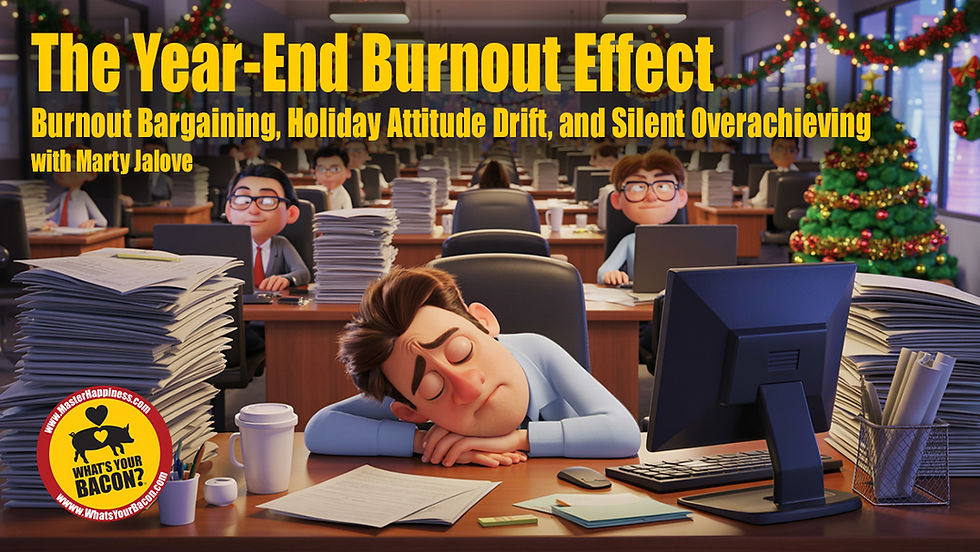
The Year-End Burnout Effect: How to Spot and Address Burnout Bargaining, Holiday Attitude Drift, and Silent Overachieving
It’s that time of year again. The time of twinkling lights, festive cheer, and a collective feeling of being completely and utterly overstuffed. We overeat at holiday parties, overspend on gifts, and overcommit to social events. Our personal batteries are running low, our patience is wearing thin, and our budgets are screaming for mercy.
Now, imagine bringing that feeling to work.
This is the Year-End Burnout Effect. It’s the inevitable collision of professional pressures and personal holiday stress. The final push to hit Q4 targets meets the mad dash to buy gifts, cook meals, and entertain relatives. The result? A workforce that is tired, frayed, and running on fumes.
As a leader, you might not see it as a full-blown crisis. Instead, you'll see it manifest in more subtle, damaging ways. It's time to look past the festive decorations and see what’s really happening with your team. Let’s explore the three most common faces of year-end burnout and what you can do to help your team make it to the New Year with their sanity intact.

Burnout Bargaining: The Art of the Subtle Pushback
Have you ever filled your plate at a holiday buffet, knowing you’ve taken too much? You start negotiating with yourself. "Okay, I'll just have a small piece of pie." "I'll skip the dinner roll to make room for the turkey." You're not refusing to eat; you're trying to manage an overwhelming situation.
Burnout Bargaining is the professional version of this. It’s when exhausted employees start subtly negotiating their workload to survive the end-of-year marathon. They aren't refusing to work; they are trying to reclaim a sliver of energy. They hint at needing lighter loads, push back gently on deadlines, or use their paid time off in strange, piecemeal ways.
Signs of Burnout Bargaining:
The PTO Puzzle: They take a random Tuesday off or ask to leave two hours early on a Thursday. It’s not a full vacation; it’s a desperate attempt to catch a breath.
The Deadline Shuffle: When a new project is assigned, they don't say "no." Instead, they ask, "Does this need to be done before the holiday?" or "Can we push this to January?"
The "Capacity" Conversation: They start using phrases like, "I'm at capacity," or "My plate is pretty full right now." This is a polite, professional way of screaming for help.
This isn't a sign of a lazy employee. It's a sign of a responsible one who knows they are close to their breaking point and is trying to avoid a crash.
How to Support a Burnout Bargainer: Your strategy is to offer relief, not resistance. Be the L.I.F.T.
Listen and Validate: When an employee pushes back, don't just hear the objection; hear the exhaustion behind it. Say, "I hear you. It sounds like you have a lot on your plate. Let's look at it together."
Identify Priorities: The end of the year is filled with "urgent" tasks. Sit down with your team and triage. What absolutely must get done now? What can wait? Give them permission to let the less critical items slide. Here's a Cheat Sheet you can use: CLICK HERE
Force a Break: Don’t just approve PTO; encourage it. Say, "I want you to take a real break. Please don't check your email." Model this behavior by taking your own time off.
Team Up: Can a project be shared? Can two people tackle a task that was assigned to one? Fostering collaboration can lighten the load for everyone.

Holiday Attitude Drift: When Stress Wears a Grumpy Mask
Think about the stress of holiday travel. The long lines, the flight delays, the crying children. Even the most patient person can find their temper shortening. You might snap at a gate agent or get frustrated with your family. It's not because you're a bad person; it's because your emotional reserves are depleted.
Holiday Attitude Drift is when this stress spills over into the workplace. You’ll see a noticeable shift in an employee's demeanor. They become less patient, more reactive, and emotionally checked out. Their usual positive attitude drifts into irritability. This isn’t intentional insubordination; it's a symptom of being stretched too thin.
Signs of Holiday Attitude Drift:
The Short Fuse: Small issues that they would normally handle with ease now trigger an outsized, frustrated reaction.
Customer Service Cracks: A normally empathetic employee becomes curt with customers or colleagues. Their patience wears visibly thin.
The Emotional Ghost: They are physically present but emotionally gone. They seem distant, distracted, and disengaged from the team's social fabric.
This drift is a direct result of stress. Personal pressures from home, financial worries, family obligations, and the general chaos of the season are depleting the energy they need to be their best selves at work.
How to Correct the Drift:Your approach should be one of empathy, not scrutiny. Be a P.A.U.S.E. for your team.
Provide Empathy: Acknowledge the pressure. Start a meeting by saying, "I know this time of year is a lot for everyone, personally and professionally. Let’s support each other."
Allow Flexibility: Can you offer more flexible hours? Can some work be done from home? Giving employees a bit more control over their schedule can significantly reduce stress.
Uncover the Source: In a private, one-on-one setting, check in. Ask, "How are you really doing? You seem like you have a lot on your mind." This opens the door for a real conversation.
Share Resources: Remind your team about any mental health or wellness resources your company offers.
Encourage Disconnection: Explicitly tell your team to leave work at work. The holidays are a time for family and rest, and protecting that time is crucial for their well-being.

Silent Overachieving: The Danger of Finishing Too Strong
At the other end of the spectrum is the person who tries to do it all. They are the ones who bake three dozen cookies for the school bake sale, host a flawless holiday dinner, and buy the perfect gift for everyone on their list. They are amazing, but they often end the season in a state of complete collapse.
Silent Overachieving is the workplace parallel. These are your high performers, the ones who feel an immense pressure to finish the year with a bang. They take on more work, refuse to let any ball drop, and push themselves to the absolute limit. It might look like incredible dedication, but it’s a direct flight to burnout.
Signs of a Silent Overachiever:
The Late-Night Emailer: You see their emails coming in at 11 PM or on a Sunday. They are constantly connected.
The PTO Martyr: They have a full bank of unused vacation days and brag about not needing a break.
The "I'll Do It" Reflex: They volunteer for every new task, even when their plate is already overflowing. They can't say no.
These are often your most valued employees, and they are also your biggest burnout risks. They won't ask for help, so you have to intervene.
How to Protect Your High Performers:You need to be the one who gives them permission to stop. Be their S.T.O.P. sign.
Set Boundaries: Mandate time off. Say, "You've done incredible work. I need you to take the last week of the year off to recharge. That's an order."
Take Something Off Their Plate: Review their workload and forcibly delegate one of their tasks to someone else. They won't do it themselves.
Offer Perspective: Remind them that this is a marathon, not a sprint. Say, "I need you for the long haul. Your energy and well-being are more important than this one deadline."
Praise the Person, Not Just the Output: Recognize their hard work, but also praise their decision to rest. Say, "I'm so glad to see you taking a break. You've earned it, and we need you back at 100% next year."
A Season of Support
The end of the year asks a lot from everyone. As leaders, our instinct is to push for that final goal, to cross the finish line. But the most important thing we can do is look at the people running alongside us and make sure they have the support they need to finish the race without collapsing.
Don’t get so focused on the year-end results that you miss the burnout happening right in front of you. Your empathy, your support, and your willingness to protect your team’s well-being are the greatest gifts you can give this holiday season.
Manage the burnout now, and you’ll have a re-energized, loyal, and grateful team ready to take on the world with you in the New Year.
For more on this subject, check out:

About Marty Jalove
Marty Jalove is the driving force behind Master Happiness, known for his infectious optimism, decades of business coaching experience, and a knack for igniting passion in teams and individuals alike. As a sought-after motivational speaker, team-building expert, and creator of the "What's Your BACON?" framework, Marty's blend of humor, heartfelt insight, and actionable strategies have helped countless organizations find focus, foster gratitude, and turn potential into real progress. His workshops and coaching sessions do more than inspire, they equip businesses to build resilient, happy, and connected teams. Ready to take your business from surviving to thriving? Reach out to Marty at MasterHappiness.com and discover the power of happiness-driven success.
#QuietQuitting #EmployeeEngagement #LeadershipTips #TeamBuilding #WorkplaceCulture #GratitudeAtWork #MotivationalLeadership #EmployeeRetention #WorkLifeBalance #MasterHappiness #MartyJalove #HappinessAtWork #BusinessSuccess #TeamMotivation #WorkplaceWellness #PositiveLeadership #EndOfYearGoals #WhatsYourBacon


Comments